
BLOOD ON THEIR HANDS
Between 1900 and 2026, an estimated 160 to 200 million people were killed in armed conflicts, genocides, state massacres, and deliberate famines. Of those, a fraction of one percent were killed by actors who faced any meaningful international legal accountability. The rest walked free. Blood on Their Hands is a comprehensive, deeply researched investigation into 25 states, governments, and armed entities responsible for the largest concentrations of civilian death, war crimes, crimes against humanity, and genocide across 126 years of modern history. Drawing on findings from the International Criminal Court, the International Court of Justice, UN Human Rights Council investigations, declassified government archives, and independent academic research, this article ranks each actor by cumulative scale, judicial documentation, and structural impunity from Nazi Germany and Imperial Japan to Gaza, Sudan, and Kashmir. No country has been omitted on the grounds of alliance status. No finding has been softened to spare a government's reputation. Because the first step toward justice is refusing to look away.
WAR, HUMAN RIGHTS & INTERNATIONAL ACCOUNTABILITY
Naeem Abbas
3/9/202635 min read
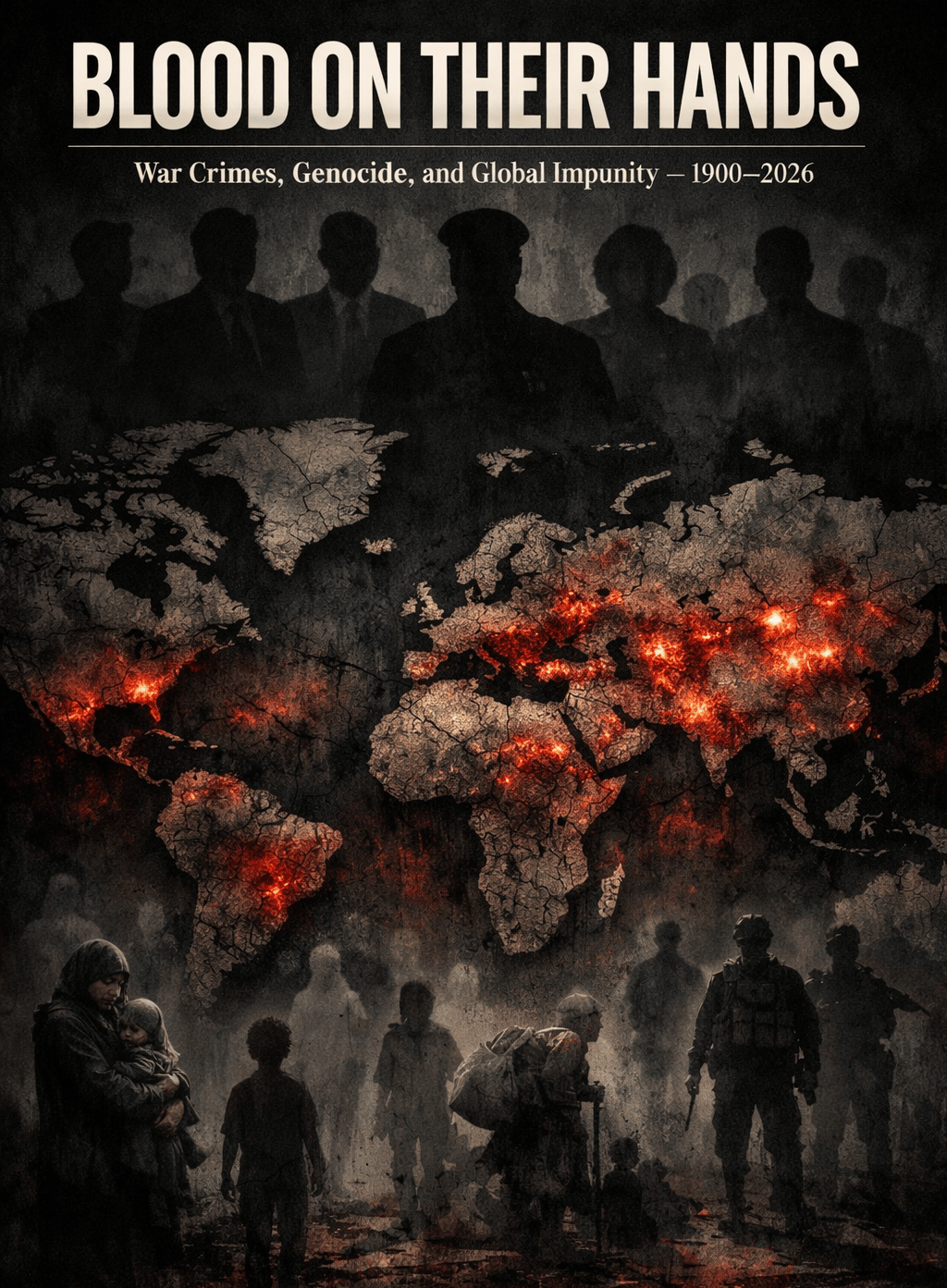
BLOOD ON THEIR HANDS
The Definitive Record of Every Nation That Killed Civilians,
Committed Genocide, and Walked Free — 1900 to 2026
The Article That Power Does Not Want Published
By Naeem Abbas
Activist — War, Human Rights & International Accountability
March 2026
"The most dangerous lie in modern history is not that these crimes did not happen. It is that the people who committed them faced justice."
THE HUMAN'S THEY CANNOT BURY
Somewhere between 160 and 200 million people were killed in armed conflicts, genocides, state massacres, and deliberate famines in the twentieth and early twenty-first centuries. This number is so large that it resists ordinary comprehension. It is larger than the current population of Russia. It is nearly two-thirds of the population of the United States. If every one of those deaths had produced a single line of text, the document would stretch from London to Cairo.
Of those 160 to 200 million people, a fraction of one percent were killed by actors who faced meaningful international legal accountability. The vast majority of perpetrators including heads of state, military commanders, intelligence directors, and political architects of mass death lived out their natural lives. Many were celebrated. Some received state funerals. Others wrote memoirs. A handful received Nobel Peace Prizes.
This article is about the gap between those two facts. It is a documented record of 25 states, governments, and armed entities responsible for the largest concentrations of civilian death, war crimes, crimes against humanity, and genocide across the 126 years between 1900 and March 2026. Each entry is grounded in the findings of international courts, UN investigations, independent academic research, and in several cases the perpetrators' own documents.
The rankings are calibrated by cumulative scale, judicial documentation, duration of conduct, and structural impunity. They incorporate findings from the International Criminal Court, the International Court of Justice, the International Criminal Tribunals for the Former Yugoslavia and Rwanda, the Extraordinary Chambers in the Courts of Cambodia, the UN Human Rights Council, the UN Office of the High Commissioner for Human Rights, the Organisation for the Prohibition of Chemical Weapons, Amnesty International, Human Rights Watch, Brown University's Costs of War Project, the Uppsala Conflict Data Programme, the Bureau of Investigative Journalism, and the US Senate's own classified reports declassified under public pressure.
No country has been omitted on the grounds of current alliance status. No finding has been softened to spare a government's feelings. This is not a comfortable document to read. It was not comfortable to write. But the alternative to look away again is precisely what produced the impunity that permitted the next atrocity, and the one after that, and the one that is happening right now, as you read this, in Sudan.
THE RANKINGS: 25 NATIONS AND ACTORS BY DOCUMENTED ATROCITY
Ranked by cumulative severity, scale, judicial documentation, and pattern of conduct across the full 126-year period. Rankings incorporate: international tribunal convictions, ICJ findings, ICC proceedings and arrest warrants, UN Human Rights Council investigations, UN Fact-Finding Mission reports, OPCW findings, independent scholarly consensus, and credible humanitarian documentation where formal proceedings have been blocked by political veto.
RANK 1 — NAZI GERMANY (1933–1945)
Classification: Genocide | Crimes Against Humanity | War Crimes
Accountability Status: Partially Prosecuted — Nuremberg Tribunal 1945–49
The Third Reich remains, by every measurable standard, the most extensively documented case of state-organized genocide in recorded history. According to the United States Holocaust Memorial Museum, the Nazi regime and its collaborators murdered approximately 17 million people between 1933 and 1945 of whom 6 million were Jewish victims of the Holocaust, the systematic extermination program now recognized as one of the most documented crimes in human history.
The Holocaust was not a byproduct of war. It was organized through a civilian bureaucratic apparatus, approved at the highest levels of the German state, and executed with industrial efficiency. The Einsatzgruppen mobile killing units murdered an estimated 1.5 to 2 million people in mass shootings across Eastern Europe. The five killing centres of Operation Reinhard Belzec, Sobibor, Treblinka, Auschwitz-Birkenau, and Chelmno murdered a further 2.7 million Jewish victims in gas chambers. A research study published in the Proceedings of the National Academy of Sciences identified a 100-day killing surge in mid-1942 during which more than 1.47 million Jews over 25 percent of all Holocaust victims were murdered in the most concentrated single killing campaign in recorded history.
Beyond the Holocaust, the Nazi regime killed approximately 3.3 million Soviet prisoners of war through deliberate starvation, 1.8 million non-Jewish Polish civilians, 220,000 to 500,000 Roma, between 200,000 and 250,000 people with disabilities through the T4 euthanasia programme, and an estimated 5,000 to 15,000 gay men. The siege of Leningrad starved approximately 800,000 civilians over 872 days. An estimated 200,000 to 250,000 Germans were directly involved in killing Jews; if one includes the broader organizational apparatus, that number rises to 500,000.
The Nuremberg Tribunal of 1945 to 1946 established the foundational legal precedent that heads of state and military commanders could be prosecuted for crimes against humanity and genocide. It convicted 12 senior Nazi leaders to death and sentenced others to prison terms. What Nuremberg did not and could not establish was whether the same framework would be applied to the victors. That question has defined the subsequent 80 years of international criminal law.
RANK 2 — IMPERIAL JAPAN (1931–1945)
Classification: Crimes Against Humanity | War Crimes | Systematic Atrocity
Accountability Status: Partially Prosecuted — Tokyo Tribunal 1946–48; Major Crimes Excluded by US Design
The war Imperial Japan waged across Asia from 1931 to 1945 occupies a fraction of the space in Western historical consciousness relative to its actual scale of destruction. Conservative estimates place civilian deaths from Japanese military operations across China, Korea, Southeast Asia, and the Pacific at between 5 and 10 million a toll that rivals or exceeds the entire European theatre of World War II outside the Holocaust.
The Nanjing Massacre of December 1937 remains one of the most documented single atrocity events of the twentieth century. Over six weeks, Japanese troops committed mass killings, mass rape, looting, and arson across the Chinese capital. Contemporary accounts and postwar Tokyo Tribunal testimony estimated civilian and prisoner-of-war deaths exceeded 200,000 with some Chinese historical estimates reaching 300,000. Commanding General Matsui Iwane explicitly ordered his soldiers to loot, execute civilians, and conduct mass sexual violence. The scale was such that German diplomat John Rabe a Nazi Party member present in Nanjing sent protests to Hitler describing what he witnessed.
Unit 731 the Imperial Japanese Army's biological and chemical warfare research programme conducted lethal human experimentation on an estimated 3,000 to 12,000 prisoners at its Pingfang facility alone. Prisoners, primarily Chinese civilians, were infected with plague, anthrax, typhoid, cholera, and syphilis; subjected to vivisection without anaesthesia; frozen alive to study frostbite; exposed to chemical weapons and explosive devices; and, according to surviving researcher testimony, referred to internally as "logs." Field operations spread plague-infected fleas over Chinese cities from low-flying aircraft. Cholera biowarfare in Yunnan province alone killed an estimated 210,000 people in 1943. A further 200,000 died from plague and cholera bacteria spread in Shandong province that same year. Over 50,000 died from bubonic plague spread in Zhejiang province in 1942.
The comfort women system enslaved an estimated 200,000 women from Korea, China, the Philippines, and occupied territories in state-organized sexual servitude. The institutionalized rape programme operated across all theatres of Japanese occupation from the late 1930s through 1945. Japan has never paid reparations to surviving victims. The Tokyo Tribunal convicted 25 Class A war criminals but explicitly excluded Unit 731's crimes entirely because the United States wanted the biological warfare research data and immunized Emperor Hirohito from prosecution by political calculation. The scientists who conducted lethal experiments on prisoners were given immunity by General Douglas MacArthur in exchange for sharing their data. They returned to Japanese society and several held prestigious academic and medical positions. No Unit 731 researcher has ever been prosecuted anywhere in the world.
RANK 3 — SOVIET UNION / STALIN ERA (1924–1953)
Classification: Genocide (Holodomor) | Crimes Against Humanity | Mass Political Killing
Accountability Status: Never Prosecuted Internationally — Co-Author of Nuremberg Framework
Stalin's Soviet Union carried out the Holodomor of 1932 to 1933 formally recognized as genocide by more than 30 countries killing between 3.5 and 7.5 million Ukrainians through deliberate grain confiscation, sealed borders, criminalized survival, and suppression of accurate death reporting. The policy was not a miscalculation. Soviet documents show officials were informed of mass starvation in real time and continued enforcing grain quotas and restricting movement. Historian Robert Conquest and the Uppsala Conflict Data Programme document that the Holodomor was accompanied by deliberate disinformation Soviet officials denied the famine was occurring while Ukrainian villages were physically emptied of food.
The Great Purge of 1936 to 1938 executed approximately 750,000 people and sent between 1.3 and 1.8 million more to the Gulag labour camp system. Ethnic deportations of Chechens, Crimean Tatars, Volga Germans, Koreans, and other peoples during and after World War II killed tens of thousands during forced transport and hundreds of thousands in resettlement conditions. The Katyn massacre of April and May 1940 executed 22,000 Polish military officers, intellectuals, and civil servants on Stalin's direct order a crime the Soviet Union blamed on Nazi Germany until 1990. Total excess deaths attributable to Soviet state violence under Stalin are estimated by demographers at between 6 and 20 million, depending on methodology.
The Soviet Union was a founding permanent member of the UN Security Council and a co-author of the Nuremberg framework it helped design. No Soviet official was ever prosecuted internationally for any of these crimes. The architecture of impunity was, in this foundational sense, built into the post-war order from its first day of existence.
RANK 4 — MAO'S CHINA / PEOPLE'S REPUBLIC (1949–1976, AND CONTEMPORARY)
Classification: Crimes Against Humanity | Mass Political Killing | Engineered Famine | Ongoing Uyghur Persecution
Accountability Status: Never Prosecuted Permanent Security Council Veto; UN OHCHR: Xinjiang Practices 'May Constitute Crimes Against Humanity'
The Great Leap Forward famine of 1959 to 1961 killed between 20 and 45 million people the deadliest single man-made catastrophe in recorded human history through forced collectivization, grain export quotas maintained during mass starvation, and the systematic suppression of accurate death reporting. Historian Frank Dikotter, working from newly accessible provincial archives, documented that local officials who reported deaths accurately were punished those who falsified upward production figures were promoted. The famine was not a policy failure. It was a policy outcome, continued with full knowledge of its consequences.
The Cultural Revolution of 1966 to 1976 killed between 500,000 and 2 million people directly through political violence, public executions, and persecution of intellectuals, religious believers, and "class enemies." Land reform campaigns in the early People's Republic executed an estimated 1 to 2 million people publicly in mass campaigns. Total deaths attributable to Maoist political violence, excluding the famine, are estimated at between 1 and 3 million.
In contemporary China, the UN High Commissioner for Human Rights found in August 2022 that Chinese government practices against Uyghurs in Xinjiang "may constitute international crimes, in particular crimes against humanity." Between 1 and 1.8 million Uyghurs have been held in mass extrajudicial detention facilities. Documented practices include forced sterilization, destruction of mosques and religious sites, prohibition of cultural and religious expression, saturation-level surveillance, and systematic forced labour programmes integrated into supply chains that reach Western consumer markets. Multiple countries have passed parliamentary resolutions characterizing the practices as genocide. China holds a permanent Security Council veto. No proceedings are possible.
RANK 5 — OTTOMAN EMPIRE / MODERN TURKEY (1914–1923, ONGOING DENIAL)
Classification: Genocide — Armenian, Assyrian, Greek | Crimes Against Humanity
Accountability Status: Never Prosecuted — Denial Maintained as State Policy and Criminal Law for 110+ Years
Between 1914 and 1923, the Ottoman Empire and its successor state carried out three overlapping genocides that together killed between 1.5 and 2.5 million people and permanently erased the Christian minorities of Anatolia. The Armenian Genocide recognized by the United States, France, Germany, the European Parliament, and over 30 countries killed between 600,000 and 1.5 million Armenians through systematic mass execution and forced death marches into the Syrian desert. Women and children marched for hundreds of kilometres without food or water; those who fell were killed.
The Assyrian Genocide killed approximately 250,000 to 300,000 Assyrian Christians through massacres, forced conversions, and death marches. The Greek Genocide and forced population exchanges killed between 300,000 and 900,000 ethnic Greeks in Anatolia. Entire millennia-old communities Armenians in eastern Anatolia, Assyrians in the Hakkari mountains, Greeks in Smyrna and Pontus ceased to exist within a decade. The city of Smyrna, a cosmopolitan port of 300,000, was burned in September 1922. Thousands of Greek and Armenian civilians drowned in the harbour attempting to escape onto Allied ships that stood offshore under orders not to intervene.
All three genocides are denied by the modern Turkish state as a matter of domestic criminal law. Article 301 of the Turkish Penal Code criminalizes "insulting Turkishness," and multiple journalists, academics, and public figures have been prosecuted under it for acknowledging the Armenian Genocide. Turkey's NATO membership has provided political insulation from accountability for over a century. Contemporary Turkish military operations in northern Syria (2019) generated documented war crimes findings from Human Rights Watch and UN investigators. Turkey is not a member of the ICC.
RANK 6 — UNITED STATES OF AMERICA (1900–2026)
Classification: War Crimes | Crimes Against Humanity | Complicity in Genocide | Torture Programme
Accountability Status: Never Prosecuted — Not ICC Member; Security Council Permanent Member; Passed Legislation Authorizing Military Force Against the Court
The United States is the only country in history to have used nuclear weapons in warfare. The atomic bombings of Hiroshima and Nagasaki in August 1945 killed between 150,000 and 246,000 civilians. The US Strategic Bombing Survey, completed in 1946, concluded that Japan would likely have surrendered without the bombs and before the planned November 1945 invasion. No proceeding has ever examined the bombings under international humanitarian law. No American official has ever been charged.
In Vietnam, Operation Phoenix the CIA's counterinsurgency assassination programme resulted in the extrajudicial killing of between 20,000 and 40,000 people. The US military deployed Agent Orange across 4.5 million acres of Vietnamese territory, a herbicide now linked to cancers, birth defects, and chronic illness in an estimated 3 million Vietnamese. The My Lai massacre of March 1968 killed 504 unarmed civilians men, women, children, and infants in a single morning. Lieutenant William Calley was the only person convicted; he served three years of house arrest before a presidential pardon.
The 2003 invasion of Iraq predicated on intelligence the US government's own analysts knew was unreliable, as documented in the 2004 Senate Intelligence Committee report killed between 140,000 and 210,000 civilians directly, according to Iraq Body Count. Brown University's Costs of War Project estimates indirect deaths from the post-9/11 wars in Afghanistan, Pakistan, Iraq, Syria, and Yemen at 3.6 to 3.8 million, bringing total direct and indirect deaths to between 4.5 and 4.7 million. At least 408,749 civilians died as a direct result of these wars.
The 2014 US Senate Intelligence Committee report documented a CIA torture programme including waterboarding, rectal feeding, sleep deprivation for up to 180 hours, confinement in small boxes, and mock burial that constituted torture under the UN Convention Against Torture the United States had ratified. Zero prosecutions resulted. The Pentagon's own annual civilian casualty reports have documented patterns of civilian deaths in US drone strikes across Pakistan, Yemen, Somalia, and Syria over two decades, with in the words of Human Rights Watch "little accountability." A US Government Accountability Office report found in 2024 that an entire year's war crimes records were missing from the military command centre overseeing Middle East operations. The United States signed the Rome Statute in 2000, unsigned it in 2002, and passed legislation authorizing military force to break any American out of ICC custody. It has vetoed more than 50 UN Security Council resolutions on Israel.
RANK 7 — KHMER ROUGE CAMBODIA (1975–1979)
Classification: Genocide | Crimes Against Humanity
Accountability Status: Partially Prosecuted — ECCC Convictions 2014 and 2018; First Sitting Head of Government Convicted of Genocide in Asia
The Khmer Rouge killed approximately 1.7 to 2.5 million people between April 1975 and January 1979 between 25 and 33 percent of Cambodia's entire population, the highest proportional death toll of any genocide in the twentieth century. The regime was driven by an ideology so totalizing that survival required concealing education, religion, profession, ethnicity, and the ownership of glasses. Urban populations were expelled to forced labour in agricultural collectives. Currency was abolished. Hospitals and schools were closed. Religion was banned. Cities were emptied in days.
Ethnic Chinese, Vietnamese, Cham Muslims, and the professional and educated classes were systematically exterminated. The Security Prison S-21 at Tuol Sleng processed approximately 17,000 prisoners, of whom only 12 to 14 are known to have survived. Meticulous photographic records of every prisoner were kept an archive now preserved as testimony to what was done.
The Vietnamese invasion ended the killing in January 1979. Remarkably, the Khmer Rouge continued to hold Cambodia's United Nations seat with the support of China and the tacit acceptance of the United States, which preferred a Khmer Rouge presence to legitimizing Vietnam's intervention until 1982. Three years after the genocide ended, the perpetrators still held a UN seat. The Extraordinary Chambers in the Courts of Cambodia did not deliver its first genocide conviction until 2014 35 years after the killing stopped. Both Nuon Chea and Khieu Samphan died in custody before further proceedings could be completed.
RANK 8 — DEMOCRATIC REPUBLIC OF CONGO — ALL FACTIONS (1996–PRESENT)
Classification: War Crimes | Crimes Against Humanity | Systematic Atrocity | Resource-Driven Mass Violence
Accountability Status: Minimal ICC Convictions — Vastly Disproportionate to Scale of Documented Atrocity
The Second Congo War of 1998 to 2003 killed between 3.8 and 5.4 million people the deadliest armed conflict since World War II primarily through disease and famine caused by the deliberate destruction of health and agricultural infrastructure across a territory the size of Western Europe. Nine nations and dozens of militia factions participated, fuelled by competition over coltan, gold, diamonds, and tin minerals used in virtually every electronic device sold globally. The war and its aftermath displaced an estimated 3.5 million people.
The ICC has secured convictions of several Congo militia commanders, including Thomas Lubanga for child soldier recruitment (2012), Germain Katanga (2014), and Bosco Ntaganda for war crimes and crimes against humanity (2019). The scale of accountability is so minimal relative to the scale of documented atrocity including mass rape used as a systematic weapon of war, the killing of tens of thousands of civilians in village massacres, and the deliberate targeting of ethnic groups that it constitutes, in practice, near-total impunity. Post-war militia violence has continued with M23 backed by Rwanda, according to UN expert investigations controlling significant territory in eastern DRC and mass atrocities documented through 2026.
RANK 9 — HUTU EXTREMIST GOVERNMENT — RWANDA (1994)
Classification: Genocide | Crimes Against Humanity
Accountability Status: Prosecuted — ICTR Convictions; First Sitting Head of Government in History Convicted of Genocide
The Rwandan genocide of April through July 1994 killed between 800,000 and one million people in 100 days a killing rate that exceeded the operational pace of the Nazi Holocaust at its peak. It was accomplished with machetes, identity cards, radio broadcasts, and a government that had spent years preparing the population for mass killing through systematic dehumanization of Tutsi people as "inyenzi" cockroaches. The planning was documented in advance. General Roméo Dallaire, commanding UN peacekeepers in Kigali, sent a cable to UN headquarters in January 1994 now known as the "genocide fax" warning with specific intelligence that mass killing was being planned and requesting permission to act. He was ordered not to.
The United States government explicitly instructed its State Department officials during the genocide to avoid using the word "genocide" because the 1948 Genocide Convention would have triggered legal obligations to intervene. Spokeswoman Christine Shelley told a press conference the department preferred "acts of genocide may have occurred." 800,000 people were killed while the world's most powerful governments debated vocabulary. Former Prime Minister Jean Kambanda became the first sitting head of government in history to plead guilty to genocide before an international tribunal. The Rwandan genocide also produced a landmark the ICTR's Akayesu judgement in 1998 was the first international conviction for genocide and the first international ruling that rape constituted an act of genocide. The people in New York and Washington who ordered inaction faced no legal consequences of any kind.
RANK 10 — PAKISTAN — STATE AND MILITARY (1971–PRESENT)
Classification: Genocide | Crimes Against Humanity | War Crimes — Bangladesh | Proxy Warfare
Accountability Status: Never Prosecuted — Shielded by US Strategic Interests; Nixon's 'Tilting' Policy Documented in Declassified Archives
The Bangladesh genocide of 1971 killed between 300,000 and 3 million Bengali civilians one of the most devastating and least-discussed atrocities of the twentieth century, a range of uncertainty so vast it speaks not to scholarly dispute but to the systematic suppression of documentation. It was accompanied by one of the largest documented rape campaigns in modern armed conflict, estimated to involve between 200,000 and 400,000 women and girls over nine months. Pakistani military forces targeted Bengali intellectuals, Hindu minorities, students, and political activists for systematic execution.
The Nixon administration, which needed Pakistan as its channel to China during the opening of Sino-American relations, actively shielded Islamabad from international accountability and continued arms shipments after the killing began. US Consul General Archer Blood in Dhaka sent a cable to Washington now declassified, known as the "Blood Telegram" condemning what he called "selective genocide" and accusing the Nixon administration of "moral bankruptcy." Nixon and Kissinger dismissed it. The arms kept flowing. No Pakistani military or political official has ever faced international accountability for any of these events, more than 50 years later.
RANK 11 — UNITED KINGDOM (1900–PRESENT)
Classification: War Crimes | Crimes Against Humanity | Policy-Induced Civilian Killing | Arms Sales to Active Genocide
Accountability Status: Partial Domestic Acknowledgment Decades Later; No International Prosecution; Permanent Security Council Member
Britain's record across the twentieth and twenty-first centuries includes the Bengal Famine of 1943, which killed approximately 3 million people through deliberate policy decisions: food exports from India were maintained during mass starvation, emergency relief was refused, and Winston Churchill reportedly attributed the famine to Indians "breeding like rabbits." Economist Amartya Sen documented the famine as entirely avoidable. Historian Madhusree Mukerjee's research found Churchill rejected multiple requests for emergency food shipments. Britain has never apologized for the Bengal famine.
The systematic torture of Mau Mau detainees in British-run camps in Kenya during the 1950s including castration, sexual violence, forced labour, and killings was acknowledged in a 2013 UK High Court judgment that resulted in partial compensation for approximately 5,000 survivors, but no criminal prosecutions. The files documenting the full scope of these operations were largely destroyed before Kenyan independence. The Partition of India in 1947 carried out by Britain in 30 days after two centuries of colonial administration killed between 500,000 and 2 million people in communal violence. Bloody Sunday in January 1972 killed 14 unarmed civilians marching in Derry; a 38-year-long inquiry concluded the killings were "unjustified and unjustifiable," and one charge was brought and then dropped.
Sustained UK arms sales to Saudi Arabia for use in Yemen were ruled unlawful by the UK Court of Appeal in 2019, briefly suspended, then resumed after a government review. Human Rights Watch and Amnesty International documented UK-supplied munitions at civilian massacre sites in Yemen including the school bus strike that killed 40 children. The United Kingdom is a permanent UN Security Council member. No British official has ever been prosecuted internationally.
RANK 12 — FRANCE (1900–PRESENT)
Classification: War Crimes | Crimes Against Humanity | Complicity in Genocide
Accountability Status: No International Prosecution; Partial Domestic Acknowledgment Decades Later; Permanent Security Council Member
France's Algerian War of 1954 to 1962 killed between 300,000 and one million Algerians through military operations, systematic torture, and civilian massacres documented in real time by French journalists, military personnel, the Red Cross, and the French Communist Party, whose documentation was suppressed. The use of torture was reported by French journalist Henri Alleg in his 1958 book "La Question" which was immediately banned by the French government. France did not formally acknowledge systematic torture in Algeria until 2018, 56 years after the war ended.
A French parliamentary commission found in 2021 that France bore "overwhelming responsibilities" in the Rwandan genocide, acknowledging that French officials provided political, military, and logistical support to the Habyarimana government with knowledge of genocide preparations. French forces operated in Rwanda during the genocide itself under Operation Turquoise. The commission stopped short of characterizing French support as complicity in genocide a conclusion that Rwandan investigators and independent scholars have reached. French forces in the Sahel region Mali, Burkina Faso, Niger were the subject of documented civilian casualty allegations and were ultimately expelled by military governments that cited French misconduct as partial justification. No French official has been prosecuted internationally for any of these events.
RANK 13 — ISRAEL (1948–PRESENT)
Classification: War Crimes | Crimes Against Humanity | Genocide (ICJ Proceedings Active)
Accountability Status: ICC Arrest Warrants Issued November 2024 for Netanyahu and Gallant; Active ICJ Proceedings; UN Human Rights Council Genocide Finding September 2025
Israel is the subject of simultaneous proceedings before two international courts as of March 2026 the International Court of Justice and the International Criminal Court a situation without precedent for a Western-aligned democratic state. The ICJ found in January 2024 that South Africa's genocide case presents a plausible legal basis. The ICC issued arrest warrants for Prime Minister Benjamin Netanyahu and former Defense Minister Yoav Gallant in November 2024 for war crimes and crimes against humanity in Gaza. The UN Human Rights Council's independent commission of inquiry concluded in September 2025 that Israel bears responsibility for genocide against Palestinians in Gaza.
Military operations in Gaza from October 2023 through March 2026 have killed, according to the Gaza Health Ministry, at least 73,188 Palestinians as of February 21, 2026. Scholars have estimated 80 percent of those killed were civilians. An independent population survey published in The Lancet Global Health in early 2026 estimated 75,200 violent deaths by January 5, 2025, 34.7% higher than official Ministry figures for the same period and found the demographic composition of casualties, with women, children, and the elderly comprising 56 percent of those killed, consistent across multiple independent methodologies. A subsequent analysis by the Max Planck Institute for Demographic Research estimated that by October 2025, conflict-related deaths had likely surpassed 100,000. The Israeli military's own former Chief of Staff acknowledged in September 2025 that "more than 200,000" Gazans had been killed or injured.
Prior to October 2023, Israeli military operations had generated six separate UN Human Rights Council investigation reports documenting violations including white phosphorus use in civilian areas in Lebanon (2006) and Gaza (2008, 2014), deliberate targeting of journalists and medical workers, and systematic destruction of civilian infrastructure. The 1982 Lebanon war killed between 17,000 and 19,000 civilians. The Sabra and Shatila massacre, carried out by Lebanese Christian militias with Israeli forces surrounding the camps and Israeli commanders providing illumination a direct command connection established by Israel's own Kahan Commission killed between 762 and 3,500 Palestinian civilians. The Kahan Commission found that Israeli Defence Minister Ariel Sharon bore "personal responsibility." Sharon returned to Israeli politics and served as Prime Minister from 2001 to 2006. The United States has vetoed more than 50 Security Council resolutions on Israel and has not enforced the ICC arrest warrants.
RANK 14 — RUSSIA — POST-SOVIET (1994–PRESENT)
Classification: War Crimes | Crimes Against Humanity | Chemical Weapons Use | Unlawful Deportation of Children
Accountability Status: ICC Arrest Warrant Issued March 2023 for Putin; 5 Additional Warrants for Senior Military Officials; Russia Has Prosecuted ICC Judges in Absentia in Response
Russia's first Chechen War of 1994 to 1996 and second Chechen War of 1999 to 2009 killed an estimated 25,000 to 50,000 Chechen civilians through urban artillery destruction, extrajudicial killing, and enforced disappearances. Grozny was described by UN officials as the most destroyed city on Earth after the second war's bombardment. Russian forces and their Syrian government allies used chemical weapons on civilian populations on multiple documented occasions, including the sarin attack on Ghouta in August 2013 that killed over 1,400 people and the chlorine attack on Khan Shaykhun in April 2017 both confirmed by the Organisation for the Prohibition of Chemical Weapons. Human Rights Watch documented Russian airstrikes on at least 50 medical facilities in Syria.
The full-scale invasion of Ukraine launched February 24, 2022 had killed, according to the UN Human Rights Monitoring Mission in Ukraine, 15,172 verified Ukrainian civilians by January 31, 2026, with the true total estimated to be considerably higher. Human Rights Watch reported a 31 percent increase in civilian casualties in 2025 compared to 2024, with July 2025 marking the highest monthly toll since April 2022. Russian forces have systematically targeted Ukrainian power grids, water treatment facilities, hospitals, and residential buildings in coordinated mass-attack campaigns. The OHCHR documented that more than 1,700 Ukrainian civilians remain arbitrarily detained in Russian facilities, with torture systematic during interrogation, and the bodies of 206 Ukrainians who died in Russian detention returned to Ukraine by February 2026.
The ICC issued arrest warrants for Vladimir Putin and Maria Lvova-Belova in March 2023 for the war crime of unlawful deportation of Ukrainian children at least 16,000 by Ukraine's estimate. Four additional warrants for senior military officials followed in 2024, including former Defence Minister Sergei Shoigu and Chief of General Staff Valery Gerasimov. Russia's response was to prosecute the ICC's Prosecutor and judges in absentia in December 2025 an extraordinary act characterised by UN human rights experts as "a flagrant violation of international law and a direct attack on the independence of international justice." Putin visited Mongolia in September 2024 as a signatory to the ICC and was not arrested.
RANK 15 — SUDAN — BASHIR REGIME / SAF / RSF (1983–PRESENT)
Classification: Genocide | War Crimes | Crimes Against Humanity | Weaponization of Famine
Accountability Status: ICC Arrest Warrant Issued 2009; Bashir Traveled Freely for Years; 2025 El Fasher Massacre Declared "Clear Hallmarks of Genocide" by UN Human Rights Council
Sudan holds the singular distinction of having been the first country against whose sitting head of state Omar al-Bashir the ICC issued an arrest warrant for genocide, in March 2009, for Darfur. Al-Bashir traveled internationally, including to multiple African Union summits, for years without arrest, demonstrating in practice the exact limits of ICC process when enforcement infrastructure is absent. The Darfur genocide of 2003 to 2008 killed between 200,000 and 400,000 people through Janjaweed militia violence backed, armed, and directed by the Sudanese state, targeting the Fur, Zaghawa, and Masalit peoples. Sudan's second civil war of 1983 to 2005 killed approximately 2 million people through warfare and famine.
The civil war that erupted in April 2023 between the Sudanese Armed Forces and the Rapid Support Forces the Janjaweed's direct institutional successor constitutes, as of early 2026, the world's largest humanitarian crisis. The RSF has targeted the same non-Arab communities as the Janjaweed before them. US Secretary of State Antony Blinken formally determined in January 2025 that the RSF and allied militias had committed genocide in Sudan specifically citing systematic murder of men and boys on ethnic grounds, and mass rape of women and girls from targeted communities. Over 400,000 people have been killed, according to estimates; 11 million have been displaced the world's largest displacement crisis. Famine has been declared across multiple regions.
In October 2025, RSF forces captured El Fasher the last Sudanese Armed Forces stronghold in Darfur and a sanctuary for over 800,000 displaced civilians and carried out what the UN Human Rights Council described as showing "clear hallmarks of genocide" against the Zaghawa and Fur communities. British MPs were briefed that 60,000 killed is the low estimate for El Fasher alone. Yale University's Humanitarian Research Lab estimated that 250,000 remaining civilians had been killed, died, been displaced, or persisted in hiding following the October 26 initial massacre. Satellite images documented RSF forces burying and burning bodies to conceal the scale of the killing. The UN Human Rights Council's High Commissioner stated: "Survivors recount statements such as: 'We want to eliminate anything black from Darfur."
RANK 16 — MYANMAR — TATMADAW / SAC JUNTA (1962–PRESENT)
Classification: Genocide | War Crimes | Crimes Against Humanity
Accountability Status: ICJ Proceedings Active; ICC Investigation Open; No Convictions as of March 2026; Coup Crackdown Killed 5,000+ Civilians
Myanmar's military has conducted ethnic warfare against non-Burman minorities for over six decades against the Karen since 1948, the Kachin since 1961, the Shan continuously, and the Rohingya in escalating campaigns culminating in the 2016 to 2017 genocide. The UN described the 2017 military campaign as "a textbook example of ethnic cleansing carried out with genocidal intent." Approximately 10,000 to 25,000 Rohingya were killed in documented mass executions, approximately 18,000 women and girls were subjected to gang rape in coordinated attacks, over 350 villages were burned, and 700,000 people fled to Bangladesh where approximately one million Rohingya remain in the world's largest refugee camp, Cox's Bazar, as of 2026.
The Gambia opened ICJ genocide proceedings against Myanmar in 2019; the case remains active. The ICC opened an investigation in 2021. The military coup of February 2021 against the elected government of Aung San Suu Kyi was followed by a crackdown that killed over 5,000 civilians according to the Assistance Association for Political Prisoners. As of March 2026, civil war continues across multiple fronts, with multiple ethnic resistance armies controlling significant territory and the junta conducting airstrikes on civilian villages with aircraft and ammunition sourced partly from Russia and China, both of which have blocked Security Council action.
RANK 17 — SAUDI ARABIA (2015–PRESENT)
Classification: War Crimes — Yemen | Weaponization of Famine | Targeting of Civilian Infrastructure
Accountability Status: Not an ICC Member; Security Council Referral Blocked by US/UK Veto; Arms Sales Continued by US, UK, and France Throughout Documented War Crimes
The Saudi-led coalition's military campaign in Yemen since March 2015 has generated more than 25,000 documented air raids, of which the UN Panel of Experts identified hundreds as hitting civilian objects with no identifiable military purpose. Documented targets include hospitals, schools, markets, water treatment facilities, and civilian gatherings. The August 2018 strike on a school bus carrying 40 children in Dahyan using a US-manufactured Mark 82 bomb with the words "From the American People" stencilled on its casing killed 40 children and 11 adults. A wedding party in 2015 was struck, killing 130 civilians. The coalition's own Joint Incidents Assessment Team, established to investigate war crimes allegations, was characterized by Human Rights Watch as neither independent nor credible.
The naval and air blockade of Yemen which restricted imports of food, fuel, and medicine to a country importing 90 percent of its basic goods constitutes the use of starvation as a weapon of war, a war crime under the Rome Statute. Save the Children estimated in 2018 that approximately 85,000 children under five may have died from hunger-related causes since the war began. The UN estimates total war deaths in Yemen, including indirect deaths, at between 150,000 and 377,000. Arms supplied throughout by the United States, United Kingdom, and France all of whom have blocked or weakened Security Council resolutions that would have imposed accountability. No Saudi official has faced any accountability. The ICC referral that could change this requires Security Council authorization, which the United States and United Kingdom would veto.
RANK 18 — ETHIOPIA AND ERITREA — TIGRAY WAR (2020–2022)
Classification: War Crimes | Crimes Against Humanity | Weaponization of Famine | Systematic Mass Rape
Accountability Status: OHCHR Documentation; No ICC Jurisdiction; Near-Zero Accountability; Received ~1% of Ukraine Media Coverage for a War That Killed Proportionally More
The Tigray War was the most lethal armed conflict globally between 2020 and 2022, killing between 300,000 and 500,000 people while receiving approximately 1 percent of the media coverage devoted to Ukraine during the same period. Famine was deliberately weaponized through siege and humanitarian access denial across one of Africa's most food-insecure regions. The UN estimates 100,000 to 200,000 deaths from starvation alone the largest famine death toll of the twenty-first century. Systematic mass rape was documented on a scale affecting an estimated 120,000 women, with medical documentation from hospitals across Tigray and Amhara describing sexual violence so widespread and organized that researchers characterized it as a weapon of war deployed at strategic level.
A massacre in the holy city of Axum a site of immense religious significance for Ethiopia's Orthodox Christian community killed hundreds of civilians sheltering in and around an ancient church during a religious festival in November 2020. Ethiopian and Eritrean forces denied it occurred for months. Satellite imagery and survivor testimony documented the event. A ceasefire was signed in November 2022. As of March 2026, accountability remains near zero. Neither Ethiopia nor Eritrea is an ICC member. No Security Council referral has been attempted. The Tigray People's Liberation Front also committed documented atrocities. The asymmetry in international attention between Tigray and contemporaneous conflicts in Europe has been noted by multiple UN officials as evidence of what the UN Secretary-General called, in another context, "a world that applies a hierarchy of suffering."
RANK 19 — CAMBODIA — KHMER ROUGE / POST-WAR SUCCESSOR IMPUNITY (1975–PRESENT)
Classification: Genocide | Crimes Against Humanity
Accountability Status: Partially Prosecuted — 35 Years After the Killing Ended; ECCC Convictions 2014 and 2018; Continued Political Protection of Survivors in Cambodian Government
This entry documents not only the Khmer Rouge genocide itself addressed above at Rank 7 but the structural impunity that followed it, which is instructive as a case study in how international accountability is managed rather than delivered. The ECCC, established in 2006 after more than two decades of UN negotiations with Cambodia's government which included former Khmer Rouge officials in senior positions did not deliver its first conviction until 2014. The political sensitivity of prosecuting individuals who had been integrated into Cambodia's post-war political structure produced repeated delays and jurisdictional constraints that severely limited the court's reach. Case 003 and Case 004, which would have targeted additional perpetrators beyond the small inner circle convicted, were blocked by Cambodian government officials.
The Khmer Rouge's continued UN seat until 1982 three years after the genocide ended with the support of China, the United States, and ASEAN nations who preferred the Khmer Rouge to Vietnamese influence, is a foundational case study in how the UN system can institutionalize impunity by design. Cambodia is instructive not primarily for the scale of its atrocity addressed above but for documenting how long the international community can wait before delivering any accountability at all, and how thoroughly that delay can be structured by geopolitical interest.
RANK 20 — SYRIA — ASSAD GOVERNMENT (2011–PRESENT)
Classification: War Crimes | Crimes Against Humanity | Chemical Weapons Use | Industrial-Scale Torture
Accountability Status: Security Council Referral Blocked by Russia/China Veto; Universal Jurisdiction Convictions in Germany; Assad Government Fallen December 2024; Accountability Proceedings in Early Stages
The Assad government's conduct across the Syrian civil war from 2011 generated one of the most extensively documented war crimes records of the twenty-first century. The UN Commission of Inquiry on Syria documented evidence of: the sarin attack on Ghouta in August 2013 that killed over 1,400 people (confirmed by the OPCW) the chlorine attack on Khan Shaykhun in April 2017 (confirmed by the OPCW Joint Investigative Mechanism) systematic siege warfare and deliberate starvation of civilian populations in eastern Aleppo, Madaya, and Daraya; the deliberate targeting of hospitals and medical workers, with the WHO verifying hundreds of health facility attacks; and the industrial-scale torture and extrajudicial killing of civilian detainees documented in the Caesar photographs 55,000 images of 11,000 tortured bodies photographed by a Syrian military police photographer who defected in 2013.
The Security Council ICC referral was vetoed twice by Russia and China. Germany and France have used universal jurisdiction to convict Syrian government officials for torture Anwar Raslan, a former Syrian intelligence colonel, was convicted in Germany in January 2022 and sentenced to life imprisonment in the first conviction of a Syrian state official for crimes against humanity, establishing universal jurisdiction as the functional alternative to blocked international proceedings. Bashar al-Assad's government fell in December 2024 following rapid rebel advances. International accountability proceedings remain in their earliest stages as of March 2026.
RANK 21 — INDONESIA (1965–1999)
Classification: Crimes Against Humanity | War Crimes | CIA-Assisted Mass Political Killing
Accountability Status: Never Prosecuted Internationally; CIA Complicity Documented in Declassified US Government Records; Described by US Officials as 'One of the Worst Mass Murders of the 20th Century'
The Indonesian mass killings of 1965 to 1966 in which an estimated 500,000 to one million suspected communists were killed following the Suharto coup, with CIA assistance including provision of lists of individuals to be targeted constitute one of the largest episodes of mass political killing of the twentieth century and one of the least discussed in Western public discourse. Declassified CIA documents confirm the agency's knowledge of and participation in the killings. US Ambassador Marshall Green reported the events to Washington in real time. US officials described the killings in internal communications as "one of the worst mass murders of the 20th century." The United States cut off aid to Indonesia briefly, then resumed full relations. No Indonesian or American official has ever faced any legal accountability.
The Indonesian occupation of East Timor from 1975 to 1999 killed between 60,000 and 183,000 Timorese in a territory of fewer than one million people through military operations, famine, and disease resulting from displacement. The UN Special Panel for Serious Crimes documented specific incidents of mass killing. Senior perpetrators were not prosecuted internationally. Indonesia's military continues to operate in West Papua under conditions that Human Rights Watch and the UN Human Rights Council document as systematic repression, with restrictions on journalists and international observers making documentation difficult.
RANK 22 — NORTH KOREA — KIM DYNASTY (1948–PRESENT)
Classification: Crimes Against Humanity — Ongoing | Possible Genocide Against Political Enemies
Accountability Status: UN Commission of Inquiry Documentation (2014); No Proceedings Possible — China Blocks All Accountability; 76 Years of Governance Without International Legal Challenge
The UN Commission of Inquiry on Human Rights in North Korea concluded in 2014 that crimes against humanity are being committed in North Korea "on a scale and with a level of gravity and brutality that does not have any parallel in the contemporary world." The Commission found systematic and widespread crimes including extermination, murder, enslavement, torture, imprisonment, rape, forced abortions and other sexual violence, persecution on political, religious, racial and gender grounds, forcible transfer of populations, enforced disappearance, and starvation. An estimated 80,000 to 120,000 people are held in political prison camps kwanliso under conditions including systematic torture, forced labour producing components for export goods, starvation, and public execution.
The Commission concluded the crimes may also constitute genocide. The Kim dynasty has governed North Korea for 76 years without any international legal challenge. China, which would veto any Security Council referral and which returns thousands of North Korean escapees to the regime, has blocked every accountability mechanism. The North Korean famine of 1994 to 1998 killed between 240,000 and 3.5 million people. As of March 2026, the situation continues without change or accountability.
RANK 23 — BOSNIAN SERB ENTITY / FEDERAL REPUBLIC OF YUGOSLAVIA (1992–1995)
Classification: Genocide | Ethnic Cleansing | War Crimes
Accountability Status: Prosecuted — ICTY Convictions; ICJ Finding; First Genocide Convictions in Europe Since Nuremberg
The Srebrenica massacre of July 1995 in which 8,000 Bosniak men and boys were systematically executed over four days in a UN-designated safe zone, with Dutch UN peacekeepers present and functionally powerless was ruled genocide by the ICTY in 2004 and confirmed by the ICJ in 2007. It remains the only act formally designated genocide in Europe since the Holocaust. The four-year siege of Sarajevo, 1992 to 1996 the longest siege of a capital city in the history of modern warfare killed approximately 13,000 civilians through sniper fire and artillery bombardment. The systematic ethnic cleansing of Bosniak Muslims and Croatian Catholics from territories designated for Republika Srpska killed approximately 100,000 people and displaced over two million.
Radovan Karadžić was convicted of genocide and crimes against humanity in 2016 and sentenced to life imprisonment. Ratko Mladić was convicted of genocide and crimes against humanity in 2017 and sentenced to life imprisonment. These are the first genocide convictions in European history since Nuremberg. The ICJ found in 2007 that Serbia failed to prevent the genocide at Srebrenica and failed to punish those responsible a legal finding without precedent but did not find Serbia directly responsible for genocide itself. The legal distinction is precise the moral clarity it creates is not.
RANK 24 — INDIA — JAMMU & KASHMIR (1989–PRESENT)
Classification: Documented War Crimes | Crimes Against Humanity | Systematic Enforced Disappearances | Extrajudicial Killings
Accountability Status: No International Prosecution — AFSPA Grants Structural Immunity India Has Not Ratified Convention Against Enforced Disappearance Despite Signing it in 2007 UN Alarm at Collective Punishment 2025
In 2011, the Jammu and Kashmir State Human Rights Commission India's own statutory human rights authority submitted its inquiry findings on unmarked graves in North Kashmir. What it found was not a disputed NGO claim. It was a physical record 2,730 bodies dumped in unmarked graves across 38 sites in four northern districts. Of those bodies, 87.9 percent could not be identified. The Commission called for a detailed investigation to be completed within six months. As of March 2026 fifteen years later no such investigation has been opened.
Human rights lawyer Parvez Imroz's independent documentation subsequently mapped more than 6,000 unmarked and mass graves across the region. According to the Association of Parents of Disappeared Persons, over 8,000 persons have been subjected to enforced disappearances in Jammu and Kashmir since 1989. Between 1989 and 2009, actions by Indian military and paramilitary forces resulted in approximately 70,000 deaths. The International People's Tribunal on Human Rights and Justice in Kashmir investigated 50 alleged encounter killings and found 47 of them to be extrajudicial executions staged to appear as armed confrontations. The term "half-widows" coined by Kashmiri civil society describes the condition of women whose husbands have disappeared and who receive no information about their fate.
On August 5, 2019, the Modi government unilaterally revoked Article 370 the provision granting Jammu and Kashmir its autonomous status without Kashmiri consultation, followed by a 150-day communications blackout and mass detentions. Amnesty International documented a sevenfold increase in habeas corpus petitions under the Public Safety Act after 2019, with average detention without trial rising from 269 days to 330 days. In November 2021, human rights defender Khurram Parvez was jailed under the Unlawful Activities Prevention Act. The UN Special Rapporteur on human rights defenders called for his release. In March 2024, journalist Aasif Sultan released after more than five years in prison was immediately rearrested under UAPA.
Following the Pahalgam terrorist attack of April 2025, Indian authorities arrested approximately 2,800 individuals and carried out punitive house demolitions without court orders. UN experts stated directly "Such actions constitute collective punishment and defy the 2024 ruling by India's Supreme Court, which found that such demolitions are unconstitutional." Authorities suspended mobile internet services and blocked approximately 8,000 social media accounts including those of journalists. The UN experts condemned the terrorist attack unequivocally while adding: "All governments must respect international human rights law while combating terrorism."
India is ranked 24th well below states responsible for mass casualty events orders of magnitude larger because it is a constitutional democracy with an independent Supreme Court and an active civil society that in several cases has rebuked the government's conduct. The distinction matters. What places India on this list is the combination of documented systematic conduct in Kashmir with the structural legal impunity that the Armed Forces Special Powers Act creates a law Human Rights Watch has called for immediate repeal, which UN Special Rapporteur Christof Heyns described as having "no place in a functioning democracy." India has not ratified the Convention Against Torture (signed 1997) or the International Convention for the Protection of All Persons from Enforced Disappearance (signed 2007). Both remain unratified as of March 2026.
RANK 25 — AL-QAEDA, ISIS, AND THE TALIBAN (1988–PRESENT)
Classification: Genocide (Yazidi) | War Crimes | Crimes Against Humanity | Terrorism | Gender Apartheid
Accountability Status: ISIS: Partial Prosecution; al-Qaeda/Taliban: Minimal International Accountability
The Islamic State's genocide against the Yazidi people of northern Iraq carried out between August 2014 and 2017 killed between 5,000 and 10,000 people, enslaved between 5,000 and 7,000 women and girls in institutionalized sexual servitude, and was recognized as genocide by the UN, the European Parliament, the United States, and numerous national governments. The genocide was documented in real time satellite imagery, survivor testimony, and recovered IS administrative documents provided an evidentiary record of exceptional completeness. Some IS fighters have been prosecuted in Iraqi, German, French, and other national courts; the organizational leadership structure has faced only partial accountability.
Al-Qaeda's September 11, 2001 attacks killed 2,977 civilians in the United States. Subsequent al-Qaeda and IS attacks across more than 40 countries have killed hundreds of thousands of civilians over three decades. The Taliban's governance of Afghanistan since August 2021 has eliminated women and girls from education, employment, and public life in a policy described by UN Special Rapporteurs as gender apartheid constituting a crime against humanity the first time in history that an entire gender has been banned from public life in a country. An estimated 87 percent of Afghan women experienced elevated psychological distress by 2023, according to UN Women surveys. Al-Shabaab violence in Somalia has caused an estimated 60,000 deaths.
THE ARCHITECTURE OF IMPUNITY: A STRUCTURAL ANALYSIS
Reading these 25 rankings together reveals a system that produces impunity as its primary output not as an exception or a failure, but as a structural consequence of how the system was designed.
Of the 25 entries on this list, four have faced meaningful international prosecution Nazi Germany, Imperial Japan, the Rwandan genocidaires, and the Bosnian Serb military leadership. In each of these four cases, accountability was possible because the perpetrators were either defeated militarily, small enough to be prosecuted without triggering great-power objections, or had no protector on the UN Security Council.
In every other case the United States, Russia, China, the United Kingdom, France, Turkey, Israel, Saudi Arabia, Pakistan, Indonesia, North Korea, Syria, India the perpetrator was either a permanent Security Council member, a close ally of one, or a country whose prosecution would have required political will that no major power was prepared to supply. The common factor in impunity is not the scale of the crime. It is the geopolitical position of the perpetrator.
This is not cynicism. It is the architecture of the system, readable in its own founding documents. The UN Charter explicitly grants permanent members the power to veto any action against themselves or their allies. The United States legislated military authority to break any American out of ICC custody. Russia and China have made ICC referral structurally impossible for their own conduct and their allies' conduct. Russia's response to ICC arrest warrants against its own president was to prosecute the Court's judges in absentia.
"Justice that is selective is not justice. It is the management of appearances."
The question for the generation now living with this record the generation that has watched Gaza, Ukraine, Tigray, Sudan, and Yemen unfold in real time on its phones while Security Councils debated procedure is whether it will be satisfied with that performance, or whether it will demand the architecture that genuine accountability requires.
That architecture exists in embryonic form. Universal jurisdiction in national courts demonstrated by Germany's conviction of a Syrian intelligence colonel and ongoing proceedings against suspected Rwandan genocidaires in France and Belgium offers a viable path that cannot be vetoed. ICC arrest warrants, even unenforced, create travel restrictions, diplomatic costs, and historical record. Satellite and digital evidence has permanently changed the evidentiary landscape: it is no longer possible to deny that a village was burned, that a convoy was targeted, or that bodies were buried in a particular location on a particular date.
The evidence is in. The dead have been counted, to the extent they can be. The legal proceedings have been opened, closed, blocked, delayed, and in a handful of cases completed. The only question that remains is who, in the end, will be held responsible for this record and who, as in every century before this one, will simply walk free.
SOURCES AND DOCUMENTATION
International Courts and Tribunals: International Criminal Court official records and arrest warrant decisions | International Court of Justice judgements | International Criminal Tribunal for the Former Yugoslavia Karadžić and Mladić conviction records | International Criminal Tribunal for Rwanda Kambanda and Akayesu judgements | Extraordinary Chambers in the Courts of Cambodia | Special Panel for Serious Crimes East Timor
United Nations Bodies:
UN Office of the High Commissioner for Human Rights Ukraine monitoring reports through January 2026 | OHCHR Report on Human Rights Situation in Ukraine, June–November 2025 | OHCHR Press Release: Russia's War Against Ukraine Hits Fifth Year, February 2026 | UN Commission of Inquiry on Syria — all reports | UN Fact-Finding Mission on Myanmar 2018 | UN Commission of Inquiry on Human Rights in North Korea 2014 | UN Human Rights Council — Independent Commission of Inquiry on Gaza 2024–2025 | UN Panel of Experts on Yemen | UN Human Rights Council Human Rights Council Hearing on Sudan, February 2026 | UNRWA documentation
Research Institutions:
Max Planck Institute for Demographic Research — Gaza War Mortality Study 2025 | Brown University Costs of War Project — Post-9/11 War Deaths | Uppsala Conflict Data Programme | United States Holocaust Memorial Museum — Holocaust victim statistics | Yad Vashem documentation | International People's Tribunal on Human Rights and Justice in Kashmir — Buried Evidence 2009 | Yale School of Public Health Humanitarian Research Lab — El Fasher satellite analysis
Medical and Scientific:
The Lancet Global Health — Gaza Mortality Survey, January 2026 | eClinicalMedicine — Gaza injury study, Duke University, 2025 | PMC/PNAS — Hyperintense kill rates during the Nazi genocide | Costs of War Project — Human Toll in Gaza, October 2025
Human Rights Organizations:
Human Rights Watch World Report 2026 | Human Rights Watch — India: Repression Persists in Jammu and Kashmir, July 2024 | Human Rights Watch — India: Investigate Unmarked Graves | Amnesty International Annual Reports | Amnesty International USA — Statement on US Drone Strikes, July 2024 | CIVICUS — Human rights: the hidden casualty in Kashmir 2025
Government Documents:
US Senate Intelligence Committee Report on CIA Detention and Interrogation Programme, 2014 | US State Department Country Reports on Human Rights Practices: India 2024 | US State Department Genocide Determination: Sudan, January 7, 2025 | US Secretary of State Blinken — Sudan Genocide Determination Statement | Blood Telegram, US Consul General Archer Blood, Dhaka, 1971 (declassified) | US Department of Defense Annual Report on Civilian Casualties 2024 | US Government Accountability Office — Pentagon War Crimes Records Report 2024 | Congressional Research Service — War Crimes in Ukraine, 2024 | Congressional Research Service — War and Humanitarian Crisis in Sudan 2025 | National Security Archive — declassified US documents on Indonesia, Pakistan, Chile
Statistical Databases:
Statista — Gaza monthly fatalities through February 2026 | ACLED — Sudan conflict data | Iraq Body Count Project | Bureau of Investigative Journalism — Drone Wars Database | SIPRI Arms Transfers Database | Global Centre for the Responsibility to Protect — Ukraine and Sudan situation reports | CFR Global Conflict Tracker — Sudan
Academic Sources:
Matthew White, Atrocitology: Humanity's 100 Deadliest Achievements | R.J. Rummel, Death by Government | Frank Dikotter, Mao's Great Famine | Robert Conquest, The Harvest of Sorrow (Holodomor) | Madhusree Mukerjee, Churchill's Secret War (Bengal Famine) | Iris Chang, The Rape of Nanking | Timothy Snyder, Bloodlands | Amartya Sen, Poverty and Famines
Jammu & Kashmir Specific:
Jammu & Kashmir State Human Rights Commission Enquiry Report on Unmarked Graves, 2011 | Association of Parents of Disappeared Persons annual documentation | UN Special Rapporteur on human rights defenders — statement on Khurram Parvez | UN Experts Press Release on Indian counter-terrorism operations in Kashmir, November 2025 | ImpACT International Policy Report — Rights, Repression and Realpolitik in the Kashmir Dispute
All data and proceedings current through March 2026.
© Naeem Abbas — March 2026
Portfolio
Explore Naeem Abbas journey as an entrepreneur and influencer.
Connect
& Inspire
© 2026. All rights reserved.