
Losing Sight of Justice: Imran Khan's Vision Loss Exposes Pakistan's Fascist Regime
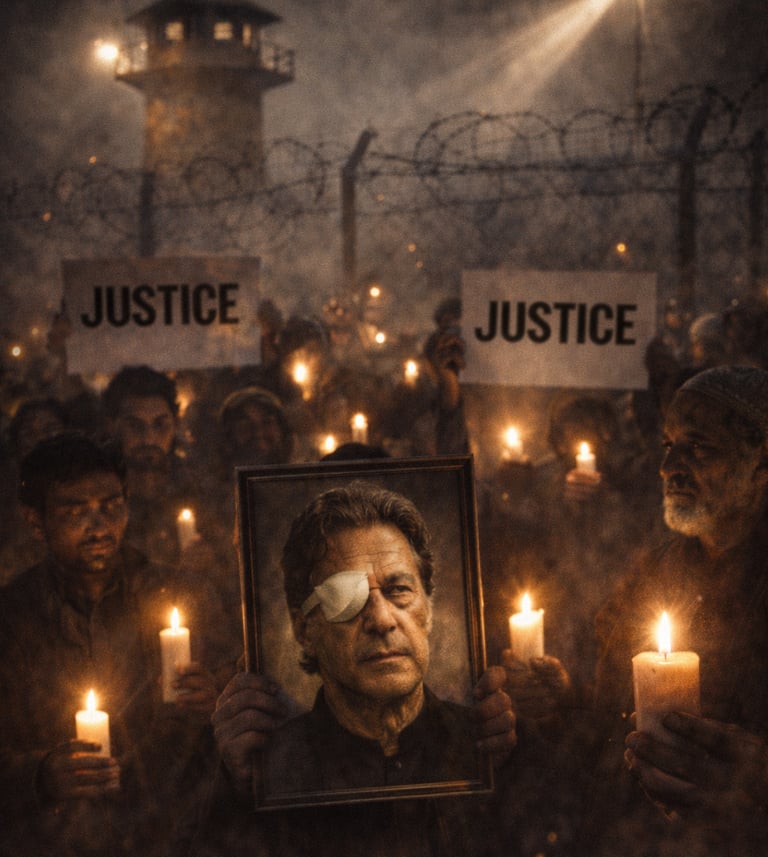
Pakistan's former Prime Minister Imran Khan has lost 85 percent of his vision in his right eye after months of alleged medical negligence in prison. The shocking revelation, confirmed by Pakistan's Supreme Court on February 12, 2026, exposes the disturbing treatment of the country's most popular political leader. Khan, imprisoned since August 2023 following what he calls a military backed regime change, repeatedly complained of blurred vision starting in October 2025. Prison authorities ignored his requests for medical care for four months until he suffered complete vision loss in his right eye. A court appointed lawyer's report revealed Khan was diagnosed with Central Retinal Vein Occlusion a blood clot requiring immediate treatment to prevent permanent blindness. The 73-year-old former cricket star has been held in solitary confinement, denied access to family and personal physicians. His sons in London have been refused visas. A secret late-night hospital visit in January raised more questions than answers. The Supreme Court has now intervened, ordering immediate medical evaluation and demanding transparency. This investigation examines Khan's journey from Prime Minister to political prisoner, the brutal crackdown on his party, and what his medical neglect reveals about Pakistan's fragile democracy and military dominance. → Read the complete Article to understand how a former Prime Minister lost his vision behind bars and what it means for Pakistan's future.
NAEEM ABBAS
2/12/20269 min read
Losing Sight of Justice: Imran Khan's Vision Loss Exposes Pakistan's Fascist Regime
Former Pakistan Prime Minister Suffers Severe Eye Damage After Months of Medical Neglect
Pakistan's political crisis has taken a deeply troubling turn. Former Prime Minister Imran Khan, imprisoned since August 2023, has lost 85 percent of his vision in his right eye after prison authorities allegedly ignored his medical complaints for months. The revelation, confirmed by Pakistan's Supreme Court on February 12, 2026, adds a disturbing new chapter to Khan's nearly two-and-a-half-year incarceration following what he and his supporters call a military-backed regime change operation.
Four Months of Ignored Pain: How Khan Lost His Vision
According to a seven-page report submitted to Pakistan's Supreme Court by court-appointed lawyer Barrister Salman Safdar, Khan's vision deteriorated rapidly between October 2025 and February 2026. The 73-year-old former cricket star and prime minister now retains only 15 percent vision in his right eye due to a condition diagnosed as Central Retinal Vein Occlusion a blood clot that causes severe retinal damage and can lead to permanent blindness without prompt treatment.
The timeline is damning. Khan told Safdar during a two-hour interview on February 10 that until October 2025, he had normal 6/6 vision in both eyes. He then began experiencing persistent blurred and hazy vision, which he repeatedly reported to the jail superintendent at Rawalpindi's Adiala Prison.
Despite multiple complaints, no action was taken for months.
"He subsequently suffered a sudden and complete loss of vision in his right eye," Safdar wrote in his report. The medical diagnosis came on February 6, 2026 nearly four months after Khan first reported symptoms.
During their meeting, Safdar observed that Khan was "visibly perturbed and deeply distressed," with watery eyes requiring tissues throughout the interview. The former prime minister's deteriorating health has become a focal point in Pakistan's ongoing political crisis.
No Family, No Doctors: Khan's Mysterious Medical Procedure
On January 24, 2026, authorities secretly transferred Khan from Adiala Prison to the Pakistan Institute of Medical Sciences in Islamabad late Saturday night for what the government described as a routine 20-minute medical procedure. He was returned to jail before sunrise Sunday.
His family was not notified beforehand.
His personal physicians were not granted access.
No detailed information about the procedure was disclosed.
Information Minister Attaullah Tarar publicly stated that Khan was "in good health" following the procedure, characterizing it as a routine matter. But Khan's party, Pakistan Tehreek-e-Insaf (PTI), strongly disputed this characterization, calling it an attempt to cover up serious medical negligence.
"The government has mishandled Imran Khan's health from the very start, first by concealing the news until it was reported by a local English newspaper, then by dismissing it as a routine matter, and ultimately by performing a procedure without the knowledge or presence of his family," said Benazir Shah, a Lahore-based political analyst.
PTI spokesman Zulfikar Bukhari demanded immediate access for Khan's personal physician, Dr. Aasim Yusuf, who has been Khan's doctor for over 20 years. Dr. Yusuf confirmed the CRVO diagnosis and explained that the condition often requires specialized injections directly into the eyeball or laser therapy treatments that must be administered promptly to prevent permanent vision loss.
"Any further delay could result in irreversible harm," Bukhari warned.
Finally, Someone Listened: The Court's Emergency Response
The Supreme Court's response came after Safdar's report painted a troubling picture of Khan's deteriorating health and prolonged isolation. Chief Justice Yahya Afridi, leading a two-member bench, ordered immediate action on February 12, 2026.
The court directed:
Formation of a medical team to examine Khan's eye before February 16
Permission for Khan to make phone calls to his sons in the United Kingdom
Full medical disclosure and transparency
"The issue of Imran's health is most important," Chief Justice Afridi observed, adding that "intervention was necessary."
The court also noted that Khan had not received any outside visitors since December 2, 2025, when his sister Uzma Khan met him for just 20 minutes. His sons, Sulaiman and Kasim Khan, who live in London with their mother Jemima Goldsmith, have been denied visas to visit their father despite applying in July 2025.
According to sources within Pakistan's Interior Ministry, the government plans to deny the visas on technical grounds rather than outright rejection a strategy designed to delay their entry indefinitely.
The Fall from Power: Understanding Khan's Arrest
To understand how Khan ended up in this situation, we must revisit the events of April 2022.
Imran Khan became Pakistan's Prime Minister in 2018 after campaigning on breaking the cycle of corruption he claimed had been imposed on Pakistan by traditional political dynasties. A former cricket captain turned philanthropist, Khan founded the Pakistan Tehreek-e-Insaf party and rode a wave of populist support to power.
But like every Pakistani prime minister before him, Khan's government operated under the shadow of the country's powerful military establishment. Pakistan's political system functions through what insiders call "the troika" the Prime Minister, the Army Chief, and the head of Inter-Services Intelligence (ISI). This arrangement means the military effectively co-governs Pakistan alongside civilian leadership.
Initially, Khan enjoyed military support. Analysts note that without backing from then-Army Chief General Qamar Javed Bajwa, Khan likely would not have won enough seats to become Prime Minister.
But the relationship soured.
Bajwa grew frustrated with Khan's economic management and angered by the Prime Minister's interference in appointing the ISI chief one of Pakistan's most powerful positions. When Khan and Bajwa's relationship collapsed, Khan's political fate was sealed.
On April 10, 2022, Pakistan's National Assembly voted 174 to pass a no-confidence motion, removing Khan from office. He became the first Pakistani prime minister to be ousted through a no-confidence vote, though no prime minister in Pakistan's 75-year history has ever completed a full five-year term.
Regime Change or Democratic Process? Khan's Explosive Allegations
Khan did not accept his removal quietly. He immediately alleged that his ouster was the result of a U.S.-backed conspiracy carried out with the support of Pakistan's military and his civilian political opponents claims denied by Washington, the Pakistani military, and opposition parties.
Khan pointed to a diplomatic cable, later published by The Intercept in August 2023, which documented a March 7, 2022 meeting where U.S. State Department officials allegedly encouraged Pakistan's government to remove Khan because of his neutrality on Russia's invasion of Ukraine.
Whether interpreted as a literal conspiracy or a metaphor for military establishment intervention, Khan's narrative resonated with millions of Pakistanis who saw his removal as undemocratic.
The Arrest That Sparked a Nation's Rage
After his ouster, Khan led energetic nationwide rallies demanding fresh elections. His popularity surged. Polls showed 61 percent of Pakistanis had a positive impression of Khan, compared to just 36 percent for his successor's party leadership.
The first arrest came on May 9, 2023, when paramilitary Rangers dramatically seized Khan from inside Islamabad High Court on corruption charges related to the Al-Qadir Trust case. The arrest sparked unprecedented protests across Pakistan.
What happened next shocked the nation.
Thousands of Khan's supporters attacked military installations something virtually unheard of in Pakistani politics. Protesters stormed the Pakistan Army's General Headquarters in Rawalpindi, set fire to the Lahore Corps Commander's house, vandalized Radio Pakistan premises in Peshawar, and attempted to breach ISI headquarters.
At least eight people died in the clashes. Nearly 1,000 supporters were arrested in Punjab province alone.
The Supreme Court ruled Khan's arrest was unlawful and ordered his release. But the damage was done. The military establishment, which historically sits at the apex of power in Pakistan and is usually untouchable, had been directly challenged.
On August 5, 2023, Khan was arrested again this time on charges of illegally selling state gifts received during foreign visits, known as the Toshakhana case. He was sentenced to three years in prison and banned from political office for five years.
Since then, Khan has faced over 150 legal cases, including charges of corruption, terrorism, and inciting violence. His party maintains all charges are politically motivated.
Inside Adiala Prison: Khan's Daily Reality
Khan has been held at Adiala Prison in Rawalpindi since August 2023, largely in solitary confinement. His lawyers and party leaders report being denied visitation access for months at a time.
Safdar's recent report to the Supreme Court detailed Khan's daily routine and living conditions. The former Prime Minister is confined to a small compound with minimal facilities, limited access to sunlight, and restricted communication with the outside world.
Phone calls to his sons have been blocked. Family visits are rare and heavily restricted. His personal physicians have been denied access. Even basic medical complaints went unaddressed for months until his vision loss became critical.
One of Pakistan's interior ministers previously described Khan as "the most privileged prisoner in Pakistan" with access to gym equipment and a cook a characterization his supporters call absurd given the documented medical neglect and isolation.
Arrests, Disappearances, and Forced Resignations
The assault on Khan's party has been systematic and devastating.
Most PTI leaders have been either arrested or forced to resign. Hundreds of party workers remain imprisoned. Amnesty International has documented cases of family members of PTI leaders being "forcibly disappeared" a tactic commonly used by Pakistan's security services against dissidents.
In July 2023, more than 100 party members were arrested. Many protesters from the May 9, 2023 demonstrations are being tried in military courts on charges of attacking military installations a decision condemned by human rights organizations as a violation of due process.
The party has lost its street power and ability to organize protests. Most leaders are either in prison or have fled the country. Those who remain face constant harassment and the threat of arrest.
Pakistan's government blocked mobile internet services during protests and disrupted access to Twitter, Facebook, and YouTube. Emergency orders banned gatherings in three of Pakistan's four provinces. Prime Minister Shehbaz Sharif called Khan's supporters "terrorists" and warned them to "behave or face punishment."
Why International Observers Are Worried About Pakistan
The treatment of Khan has raised alarm among human rights organizations and international observers.
PTI officials have called on human rights groups to monitor the situation, arguing that the treatment of a democratically elected former prime minister reflects broader concerns about the rule of law, prisoners' rights, and due process in Pakistan.
"The treatment meted out to a former prime minister for so long shows that the current government in Pakistan has scant regard for basic human rights," said Benazir Shah.
Despite these concerns, Pakistan's military-backed government has strengthened ties with Washington under the Trump administration. In early 2026, Pakistan joined Trump's "Board of Peace" initiative for Gaza, potentially including deployment of Pakistani military forces a decision that critics say demonstrates the current government's alignment with U.S. interests in ways Khan refused.
Pakistan's Unelected Rulers: Understanding Military Dominance
Pakistan's history is defined by military intervention in politics. Since independence in 1947, the country has experienced multiple coups and periods of direct military rule. No prime minister has ever completed a full constitutional term.
The current Army Chief, General Asim Munir, has consolidated power to an unprecedented degree. Under his leadership, the military has manipulated elections and unleashed a brutal crackdown on Pakistan's most popular political party.
Some observers describe the situation as Pakistan inching closer to direct military rule rather than the hybrid civilian-military arrangement that has characterized recent decades.
PTI expressed "profound concern" over Khan's treatment and warned that "any harm inflicted upon Imran Khan's health will be accounted for." The party reserves the right to initiate legal proceedings against relevant officials.
A video circulating online showed Khan's sister, Aleema Khan, breaking down upon learning he retained only 15 percent vision in his right eye. The emotional response resonated with millions of Pakistanis who view Khan as a victim of an unjust system.
Who's Responsible for Khan's Lost Vision?
Critical questions remain unanswered:
Why were Khan's medical complaints ignored for months? The former jail superintendent, Abdul Ghafoor Anjum, was transferred in mid-January 2026 around the time Khan's condition became critical. No investigation into the medical negligence has been announced.
Why was Khan's hospital visit kept secret from his family? The lack of transparency raises concerns about what treatment he received and whether it was adequate.
Why are his sons being denied visas? The refusal to allow his children to visit him, combined with restrictions on phone contact, appears designed to isolate Khan completely.
Will anyone be held accountable for his vision loss? As of February 2026, no officials have faced consequences for the apparent medical negligence.
The Crisis That Defines Pakistan's Democratic Struggle
The Imran Khan case has become a defining test for Pakistan's already fragile democracy. At stake is the fundamental question: can civilian leaders challenge military dominance without facing imprisonment, torture, or worse?
Khan's situation draws uncomfortable parallels to Pakistan's history of military interventions, political imprisonments, and extrajudicial actions against dissidents. His supporters argue that his treatment demonstrates the military establishment's willingness to crush any challenge to its authority, regardless of democratic norms or human rights.
His opponents counter that Khan himself operated through a "hybrid regime" when in power, relying on military support, and that he faces legitimate legal charges unrelated to politics.
But the medical neglect that led to Khan's severe vision loss is difficult to justify under any circumstances. Whether one views Khan as a political martyr or a flawed leader facing justice, the failure to provide basic medical care to a prisoner let alone a former head of government represents a serious violation of human rights and the rule of law.
The Uncertain Future of Pakistan's Most Popular Politician
As of mid-February 2026, Khan remains imprisoned with over 150 legal cases pending. His party is decimated, his health is deteriorating, and his political future is uncertain.
The Supreme Court has ordered medical evaluation and demanded transparency, but whether authorities will comply meaningfully remains to be seen. The pattern of restricted access, delayed treatment, and minimal accountability does not inspire confidence.
Khan's sons continue to be denied entry to Pakistan. His personal physicians remain blocked from seeing him. The full extent of damage to his vision and whether it can be reversed is unclear.
For Pakistan, the crisis reveals deep structural problems: a military that continues to dominate politics, a judiciary that struggles to enforce its rulings, and a civilian government that appears unable or unwilling to protect prisoners' rights.
Until these fundamental issues are addressed, Pakistan's democratic aspirations will remain constrained by the realities of military power.
And Imran Khan, once captain of Pakistan's cricket team and Prime Minister of the nation, sits in a prison cell with 85 percent of his vision gone a symbol of how far Pakistan's institutions have fallen when it comes to protecting the rights and dignity of all citizens, even those who challenge the powerful.
Portfolio
Explore my journey as an entrepreneur and influencer.
Connect
& Inspire
© 2026. All rights reserved.