
Money Behined Jeffrey Epstein's Crimes
The Epstein Files exposed more than one man's crimes they revealed how America's most trusted institutions became enablers. This in depth investigation uncovers the shocking financial networks that allowed Jeffrey Epstein to operate for over a decade after his conviction. JPMorgan Chase processed over $1 billion in Epstein transactions across 15 years without filing a single suspicious activity report. When they finally cut ties in 2013, Deutsche Bank eagerly took over, opening 40+ accounts despite his criminal history. Together, four major banks handled $1.5 billion in suspicious transactions and faced minimal consequences. The academic scandal runs equally deep. Harvard gave Epstein campus access and a "Visiting Fellow" title even after his conviction. MIT Media Lab director secretly accepted $800,000, marking donations as "anonymous" to bypass university policies. Elite institutions chose funding over ethics, reputation over accountability. Congressional investigations reveal Treasury files showing 4,725 wire transfers totaling $1.1 billion from just one account. Banks paid $365 million in fines but kept profiting. Universities apologized but retained the money. This follow-up investigation exposes how compliance officers ignored red flags, administrators prioritized donations, and regulatory systems moved years too late. → Read the complete Anaylsis to see how institutions chose profit over protection and enabled years of abuse.
POWER & ACCOUNTABILITY
NAEEM ABBAS
2/11/202610 min read
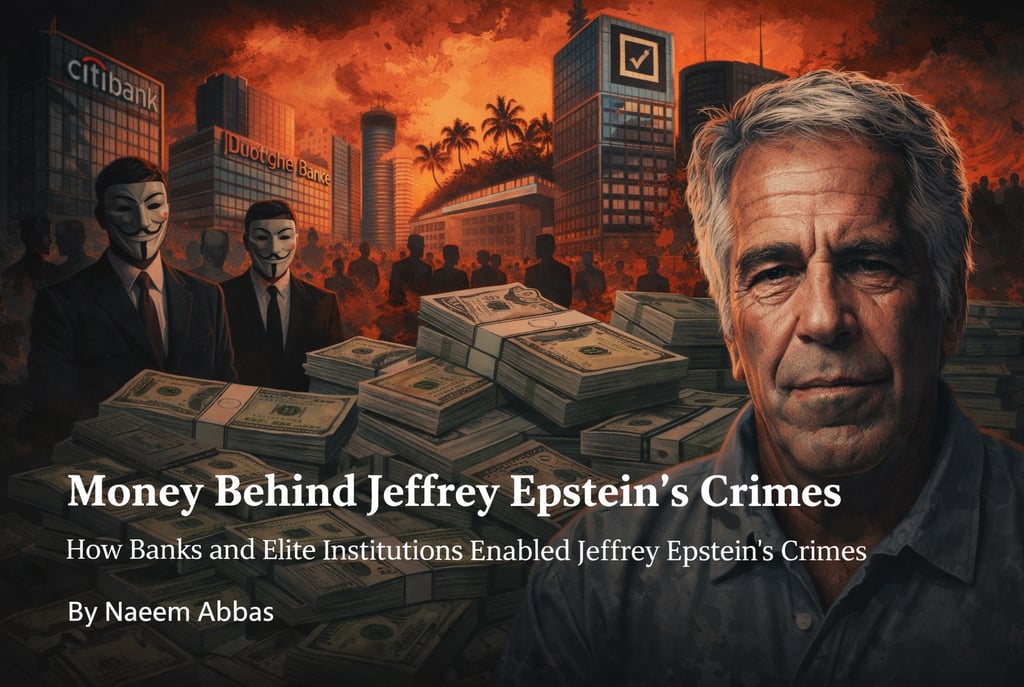
Money Behind Jeffrey Epstein's Crimes
How Banks And Elite Institutions Enabled Jeffrey Epstein's Crimes
By Naeem Abbas
Activist — Human Rights & International Accountability
While the world knows Jeffrey Epstein as a convicted sex offender, the recently released documents reveal an equally disturbing story: how America's most prestigious financial institutions and universities knowingly facilitated his operations even after his criminal conviction. This follow-up examination explores the systems that allowed Epstein to continue his activities for over a decade after law enforcement first intervened.
The Banking Scandal: $1.5 Billion in Suspicious Transactions
The financial records paint a stark picture of institutional failure. Between 1998 and 2019, at least four major American banks JPMorgan Chase, Deutsche Bank, Bank of America, and Bank of New York Mellon processed more than $1.5 billion in suspicious transactions linked to Epstein's sex trafficking operation.
JPMorgan Chase: Fifteen Years of Warning Signs
JPMorgan Chase maintained a relationship with Epstein for 15 years, from 1998 to 2013. During that time, the bank opened 134 accounts for Epstein and processed over $1 billion in transactions. Senior executives personally helped Epstein establish these accounts, even as red flags accumulated.
Congressional investigations revealed that JPMorgan failed to file a single Suspicious Activity Report on Epstein's accounts until after his death in 2019 despite federal regulations requiring banks to report unusual financial activity that might indicate illegal conduct. Internal emails showed bank compliance officers were aware of concerns but chose not to escalate them.
The bank's relationship with Epstein centered around two shell companies he controlled: Financial Trust Company and Southern Trust Company, both incorporated in the U.S. Virgin Islands. These entities generated over $800 million in revenue between 1999 and 2018, primarily from two billionaire clients: Leslie Wexner, who paid $200 million in fees, and Leon Black, who paid $170 million.
Thanks to Virgin Islands tax exemptions, Epstein's corporations saved approximately $300 million in taxes, maintaining an effective tax rate of just 4 percent despite a top marginal rate of 38.5 percent.
In 2023, JPMorgan settled two major lawsuits over its Epstein connections. The bank paid $290 million to settle a class-action lawsuit brought by Epstein's victims and an additional $75 million to settle claims from the U.S. Virgin Islands. JPMorgan also reached a $105 million settlement with the Virgin Islands Attorney General over allegations the bank helped Epstein's criminal enterprise prosper.
Deutsche Bank: The Bank That Said Yes When Others Said No
When JPMorgan finally distanced itself from Epstein in 2013 five years after his conviction Deutsche Bank eagerly stepped in to take his business.
Paul Morris, a relationship manager who had previously serviced Epstein's accounts at JPMorgan, joined Deutsche Bank in November 2012. Within months, he pitched Epstein to Deutsche Bank's senior management as a lucrative client opportunity. Internal emails show Morris estimated Epstein could generate "$100-$300 million" in flows with "$2-4 million annually" in revenue for the bank.
Deutsche Bank designated Epstein as an "honorary politically exposed person" during onboarding a designation that doesn't actually exist in standard banking compliance protocols. As one confidential witness later testified, "There is no such thing as an honorary PEP. You are either a PEP or you aren't."
Between 2013 and 2018, Deutsche Bank opened more than 40 accounts for Epstein. The bank witnessed multiple red flags that should have triggered immediate investigation:
Epstein's attorneys sent millions of dollars to women with Eastern European surnames. When compliance officers inquired about these transactions, Epstein claimed they were "consultants." The bank accepted this explanation without further verification. Large cash withdrawals occurred regularly from accounts supposedly meant for long-term investment. Transactions showed patterns consistent with payments to trafficking victims, yet the bank failed to report them promptly.
New York Department of Financial Services investigators found Deutsche Bank had "significant compliance failures" and failed to properly monitor suspicious account activity for years, despite publicly available information about Epstein's criminal history.
The relationship cost Deutsche Bank dearly. In 2020, New York regulators imposed a $150 million fine as part of a larger settlement covering multiple compliance failures. In 2023, Deutsche Bank paid an additional $75 million to settle a lawsuit from Epstein's victims who claimed the bank "knowingly benefited" from his sex trafficking.
The Broader Banking Failure
Documents obtained by Congress show the scope extended beyond just two banks. Bank of America and Bank of New York Mellon also processed substantial transactions for Epstein. Treasury Department files revealed one Epstein account alone conducted 4,725 wire transfers totaling $1.1 billion. Across all four major banks, transfers totaled nearly $1.9 billion.
Representative Jamie Raskin, ranking member of the House Judiciary Committee, demanded records from all four banks in October 2025, stating: "Financial institutions are often the first line of defense in detecting serious federal crimes, especially ones that involve significant flows of money like sex trafficking. Flagging and detecting Epstein's suspicious withdrawals may well have stopped his crimes years earlier and saved countless girls and women."
JPMorgan CEO Jamie Dimon publicly stated he "regrets any association with that man at all," but critics argue the bank's actions spoke louder than words. The banks had the information, the obligation, and the tools to stop Epstein's financial operations but chose not to act until it was far too late.
The Academic Embrace: Universities and the Epstein Money Trail
While banks processed Epstein's transactions, prestigious universities accepted his donations, provided him with academic credibility, and in some cases, gave him ongoing access to their campuses and researchers even after his criminal conviction.
Harvard University: $9.1 Million and Continued Access
Harvard University received $9.1 million from Epstein between 1998 and 2008, making him one of the institution's significant donors during that decade. The largest single gift came in 2003 a $6.5 million donation that established the Program for Evolutionary Dynamics, led by mathematician Martin Nowak.
A 2020 internal review conducted by Harvard confirmed that no donations were accepted after Epstein's 2008 conviction. The university even rejected a gift offer from Epstein following his conviction, recognizing the reputational risk.
However, the review also revealed deeply troubling facts. Between 2010 and 2018 years when Epstein was a registered sex offender he visited the Program for Evolutionary Dynamics offices more than 40 times. In 2018 alone, he made over 40 visits. He maintained an office there and continued to interact with researchers and students.
Harvard also granted Epstein the title of "Visiting Fellow" in its psychology department for the 2005-2006 academic year, after he made a $200,000 donation to the department. This gave him Harvard credentials and campus access during the period when Palm Beach police were actively investigating him for sexual abuse of minors.
After Epstein's 2019 arrest and death, Harvard faced intense criticism. In 2021, the university closed the Program for Evolutionary Dynamics and imposed sanctions on Professor Nowak, which were later lifted in 2023. Harvard redirected the remaining $186,000 of unspent Epstein donations to organizations supporting victims of sexual assault and human trafficking.
MIT Media Lab: The Anonymous Donation Scheme
The scandal at Massachusetts Institute of Technology was even more brazen. MIT's celebrated Media Lab accepted approximately $800,000 directly from Epstein after his 2008 conviction despite the university's public policy against accepting his money.
Investigative reporting by The New Yorker revealed that Media Lab director Joichi Ito not only accepted Epstein's donations but actively concealed their source. Internal emails showed Ito instructed staff to mark Epstein's contributions as "anonymous" to avoid scrutiny from university administrators who might reject the funds.
The deception went deeper. Documents showed Epstein arranged at least $7.5 million in donations to the Media Lab from other wealthy individuals, effectively laundering his influence through proxies. This included $2 million that Epstein claimed to have solicited from Bill Gates, though a Gates representative later stated the money wasn't dedicated to programs Epstein was fundraising for.
After these revelations emerged in August 2019, Ito resigned from both his position at MIT and his visiting professorship at Harvard Law School. MIT President Rafael Reif issued an apology to Epstein's victims, but faced calls for his own resignation. Dozens of students and faculty protested, chanting "Reif! You can't hide! We demand that you resign!"
The MIT scandal prompted other universities to review their donor vetting procedures and raised fundamental questions about anonymous donations in higher education.
The Scientific Network: Reputation as Currency
Beyond direct donations, Epstein cultivated relationships with dozens of prominent scientists across multiple institutions. Documents released in early 2026 revealed Epstein maintained a list of nearly 30 top scientists and showed previously unknown connections with many of them.
These included:
Princeton University: Physicist Lisa Randall visited Epstein's private Caribbean island in 2014 and exchanged emails joking about his house arrest. She later expressed deep regret about maintaining contact.
University of Pennsylvania, Cornell, and UCLA: These institutions appeared on Epstein's foundation websites as recipients of his philanthropy, though exact amounts and details remain unclear due to incomplete public records.
Santa Fe Institute: Ghislaine Maxwell told Department of Justice investigators in a July 2025 interview that she introduced Epstein to the Santa Fe Institute through connections from her father, Robert Maxwell, who founded scientific publisher Pergamon Press. Epstein was particularly fascinated by brain science and evolutionary biology.
Recent document releases showed scientists consulting Epstein on research publications, visa applications, and funding opportunities. Email correspondence revealed some researchers provided wire transfer details for payments to individuals in Eastern Europe, later explaining these were legitimate scholarships though the pattern raised questions given Epstein's known trafficking methods.
Why Did Institutions Take the Money?
Universities faced a difficult calculation. Epstein's donations, while significant to individual programs, were relatively modest compared to the hundreds of millions raised annually by elite institutions. Harvard's $6.5 million gift represented less than 0.02 percent of its endowment at the time.
Yet administrators accepted the money for several reasons:
Aggressive fundraising culture: Universities compete intensely for donations to fund research, programs, and buildings. Development officers are evaluated partly on their ability to secure gifts.
Prestige by association: Epstein cultivated connections with Nobel laureates and prominent intellectuals. His association with respected scientists lent him credibility that universities valued.
Compartmentalized decision-making: Donations were often accepted at the department level without full institutional review, allowing individual administrators to approve gifts that central offices might have questioned.
Reputation laundering: Critics argue Epstein deliberately sought academic affiliations to legitimize himself and obscure his criminal activities. Universities provided that legitimacy in exchange for funding.
The Congressional Investigation: Seeking Answers
The House Oversight Committee launched a comprehensive investigation in 2025, issuing subpoenas to banks, universities, and government agencies. The committee has released approximately 65,000 pages of documents to date, including:
Financial records from JPMorgan Chase and Deutsche Bank: These showed the full scope of Epstein's transactions and the banks' compliance failures.
Photos and videos from Epstein's private island: In December 2025, Democrats on the committee released 73 never-before-seen photos and four videos of Epstein's estate on Little St. James island in the U.S. Virgin Islands. The images showed bedrooms, a dental chair, and other disturbing details of the compound where abuse allegedly occurred.
Testimony from former officials: The committee conducted depositions with former U.S. Attorney Alexander Acosta, who approved the controversial 2008 plea deal, and former Attorney General William Barr. Several former FBI directors and attorneys general submitted formal declarations stating they had no information about the Epstein or Maxwell cases.
Communications from the Clintons: The committee issued deposition subpoenas to Bill and Hillary Clinton. As of February 2026, the committee remains in communication with the Clintons' attorneys about scheduling their depositions.
Representative Robert Garcia, ranking Democrat on the Oversight Committee, stated: "These new images are a disturbing look into the world of Jeffrey Epstein and his island. We are releasing these photos and videos to ensure public transparency in our investigation and to help piece together the full picture of Epstein's horrific crimes."
What the Files Still Don't Answer
Despite millions of pages of documents and ongoing congressional investigations, critical questions remain:
Who knew what, and when? Bank executives and university administrators claim they acted on limited information, but internal documents often contradict these claims. The full extent of institutional knowledge remains unclear.
Were there other major co-conspirators? Ghislaine Maxwell remains the only person from Epstein's inner circle serving prison time. Documents reference other individuals who allegedly recruited victims or facilitated abuse, but no additional prosecutions have occurred.
What was Epstein's actual business? Financial records show he received hundreds of millions in fees from just two clients. Yet the nature of the "services" he provided remains opaque. Was he truly a financial advisor, or was his wealth derived from other sources?
How much money remains unaccounted for? Treasury Department files show over $1.1 billion in wire transfers from one account alone. The full scope of Epstein's financial network including offshore accounts, shell companies, and hidden assets has never been fully mapped.
Why did the system fail so completely? The 2008 plea deal, the banks' compliance failures, the universities' continued associations each represents a separate institutional failure. But together they reveal something more troubling a pattern where power, wealth, and connections can override laws, regulations, and basic ethical standards.
Institutional Reform: Too Little, Too Late?
In the wake of these revelations, institutions have announced reforms:
Banks: Enhanced monitoring of high-risk accounts, stricter compliance protocols, and additional training for relationship managers handling wealthy clients. New York regulators have imposed tighter oversight of private banking operations.
Universities: Improved donor vetting procedures, centralized review of large gifts, restrictions on campus access for donors, and policies requiring disclosure of funding sources. Several institutions have established ethics committees to review controversial donations.
Government: The Epstein Files Transparency Act mandated document releases, but implementation has been criticized as incomplete. Congress continues to push for full disclosure and accountability.
But critics argue these changes come too late for Epstein's victims and don't address the fundamental problem: institutional cultures that prioritize revenue and reputation over accountability and ethics.
The Human Cost
Behind every transaction, every donation, and every institutional failure were real victims. The files contain testimony from survivors describing how they waited years to be believed, watched their abusers remain free and prosperous, and saw institutions accept money stained by their suffering.
Many survivors have expressed frustration that the massive document releases focused more on powerful names than on their stories. Some noted that their identifying information was poorly redacted while influential individuals' details were better protected a final indignity from systems that failed to protect them in the first place.
Looking Forward
The Epstein case exposed not just one man's crimes but systemic failures across multiple pillars of American society law enforcement, banking, higher education, and regulatory oversight. The question now is whether institutions will truly reform or simply wait for public attention to fade.
The files reveal a disturbing truth Jeffrey Epstein operated in plain sight for decades because powerful institutions chose to look the other way. Banks processed suspicious transactions because he was profitable. Universities accepted his money because they needed funding. Prosecutors offered lenient deals because he had powerful connections.
Until institutions face real consequences for enabling abuse, until whistleblowers are protected rather than punished, and until wealth and power stop serving as shields against accountability, the pattern will repeat.
The Epstein Files are not just about one predator. They're a mirror showing us exactly how our most trusted institutions behave when ethics conflict with interests. And what they reveal should disturb us all.
© Naeem Abbas
Portfolio
Explore Naeem Abbas journey as an entrepreneur and influencer.
Connect
& Inspire
© 2026. All rights reserved.